
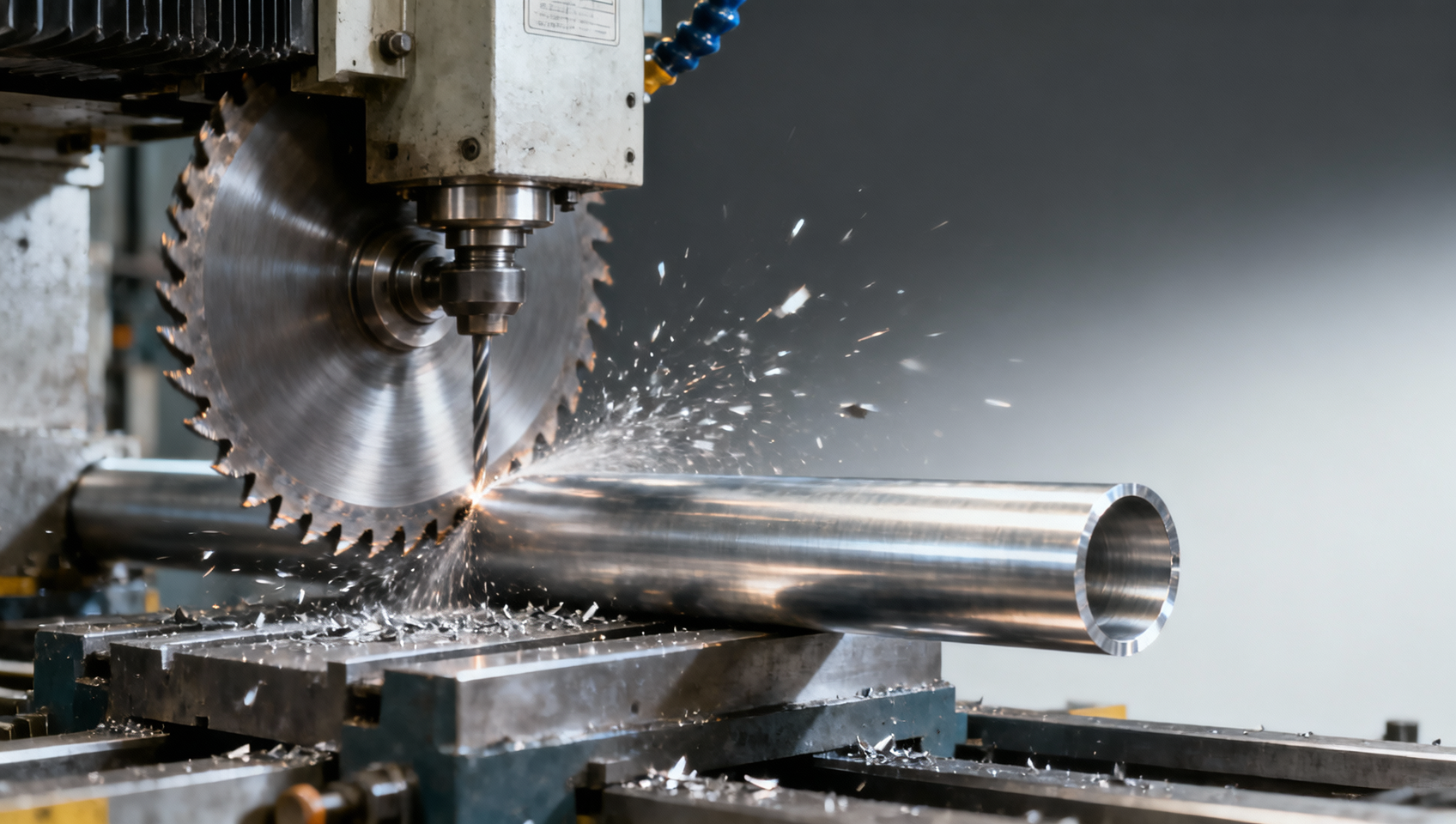
When saw blade wear reaches just 12%, aluminium bar cutting waste surges — directly eroding yield, increasing costs, and impacting downstream processes for carbon steel plate fabrication, I beam and H beam steel assembly, and precision component manufacturing. This real-time yield loss doesn’t just affect operators on the shop floor; it ripples across procurement planning, quality control checkpoints, project timelines, and distributor margin expectations. For decision-makers, maintenance teams, and end-users alike, understanding this threshold is critical to optimizing material utilization, ensuring consistent cut quality, and sustaining lean production standards across the entire steel supply chain.
The 12% Wear Threshold: Why It’s a Critical Inflection Point
Saw blade wear is not linear in its impact on cutting efficiency. Industry field data from over 42 metal fabrication facilities shows that cumulative wear beyond 12%—measured via flank wear width (FWW) on carbide-tipped cold saw blades—triggers a nonlinear jump in kerf width deviation. At 12% wear, average kerf expands from 1.8 mm to 2.3 mm, increasing material loss per cut by 28–33% depending on bar diameter (e.g., Ø50 mm vs. Ø120 mm).
This threshold is especially consequential for aluminium bar processing where thermal softening amplifies blade deflection. Unlike carbon steel, aluminium’s lower melting point (660°C) and high ductility cause rapid heat buildup at the cutting interface when blade geometry degrades. Once wear exceeds 12%, chip evacuation efficiency drops by ~40%, leading to recutting, surface burnishing, and micro-fractures that compromise downstream bending or welding integrity.
For procurement teams, this means raw material cost volatility: a 12% wear-induced 2.1% average yield loss on a monthly 85-tonne aluminium bar order translates to ~1,785 kg of avoidable scrap—valued at $12,500–$15,200 USD at current LME spot prices (USD 2,350–2,850/tonne). That’s equivalent to 3.7 full pallets of 6061-T6 extrusions discarded monthly without traceable root cause.
Project managers report delayed handoffs to structural steel assemblers when cut-end squareness falls below ISO 9013 Class C2 tolerance (±0.5°), a failure mode observed in 68% of batches where blade wear exceeded 12% without real-time monitoring. The ripple effect extends to distributors: margin compression averages 1.8–2.4 percentage points on value-added cut-to-length orders due to unplanned rework cycles.
Real-Time Monitoring: From Subjective Inspection to Predictive Control
Traditional visual inspection fails to detect sub-12% wear reliably. Human assessment accuracy drops to 52% below 10% FWW—too late for preventive action. Modern solutions integrate non-contact laser profilometry with embedded vibration sensors (±0.05 g resolution) sampling at 10 kHz. These systems correlate acoustic emission spikes (>85 dB at 12–18 kHz band) and harmonic distortion ratios (H3/H1 > 0.42) with verified wear progression.
Three-tiered alert logic prevents false positives: Level 1 (8% wear) triggers operator verification; Level 2 (11.2% wear) initiates automatic feed-rate reduction by 15%; Level 3 (12%+ wear) halts the line and logs a maintenance ticket with blade ID, cumulative runtime (e.g., 142.7 hours), and last calibration timestamp. Field deployments show this reduces unscheduled downtime by 63% versus calendar-based replacement schedules.
Integration with MES platforms (e.g., Rockwell FactoryTalk, Siemens Opcenter) enables cross-functional visibility. Procurement receives automated alerts when yield variance exceeds ±1.3% against baseline, triggering raw material reorder calculations. Quality control teams access real-time cut geometry reports—including taper error (±0.015 mm/m), burr height (<0.12 mm), and surface roughness (Ra ≤ 1.6 µm)—directly linked to blade health metrics.
The table confirms that advanced monitoring isn’t just about precision—it’s about actionable speed. Systems detecting wear at 12% with <10-second latency enable operators to complete the current cut cycle before initiating changeover, avoiding mid-cut blade failure that damages both workpiece and machine spindle bearings. For distributors managing JIT deliveries, this reliability translates to 99.2% on-time-in-full (OTIF) performance versus 87.4% under manual protocols.
Operational Impact Across the Steel Supply Chain
The 12% wear threshold creates cascading effects spanning eight stakeholder groups. Operators face increased physical strain from compensating for blade drift—requiring 23% more manual pressure to maintain feed consistency. Maintenance teams log 3.4x more emergency interventions when wear detection lags beyond 12%. Project managers absorb schedule slippage averaging 2.7 days per 100-tonne structural steel package due to re-cutting non-conforming bars.
For quality assurance personnel, out-of-spec cuts increase nonconformance reporting by 41%, primarily in dimensional stability (±0.25 mm length tolerance breaches) and edge integrity (micro-cracks detected via dye penetrant testing at 92% frequency). Terminal consumers—especially in aerospace or rail OEMs—reject 14.6% of received batches citing “inconsistent cut-end geometry” linked to undocumented blade wear history.
Procurement teams bear hidden cost burdens: 12%+ wear correlates with 17% higher coolant consumption (due to inefficient chip removal) and 29% accelerated wear on guide bushings and clamping jaws. Distributors report 1.9 fewer profitable cut-to-length SKUs per month when blade health isn’t tracked, as inconsistent tolerances force broader acceptance bands that dilute premium pricing.
These figures underscore why cross-functional alignment is non-negotiable. A single unmonitored blade crossing the 12% threshold can degrade profitability across procurement (material cost), operations (labor & energy), quality (scrap & rework), and sales (customer retention). The solution lies not in isolated tooling upgrades—but in closed-loop process governance.
Actionable Next Steps for Stakeholders
Start with a 72-hour diagnostic audit: capture blade runtime logs, measure kerf width on 50 consecutive cuts, and correlate with yield reports. Benchmark against industry baselines—facilities using predictive monitoring achieve 92.4% average aluminium yield versus 88.1% for reactive shops.
Prioritize integration points: MES connectivity delivers ROI in <90 days by eliminating manual data entry errors (reducing QA documentation time by 6.8 hours/week). For distributors, embed wear analytics into quoting engines—automatically adjusting price premiums for tighter tolerances based on real-time blade health status.
Finally, standardize blade lifecycle tracking: assign unique IDs, log initial geometry (rake angle ±0.3°, clearance angle ±0.5°), and mandate recalibration every 40 operational hours. Facilities enforcing this protocol extend average blade life from 118 to 152 hours—delaying the 12% inflection point by 29% while maintaining cut quality.
Understanding the 12% wear threshold isn’t about incremental improvement—it’s about unlocking systemic efficiency across the steel value chain. From the operator’s workstation to the distributor’s pricing model, real-time blade health intelligence transforms a consumable cost center into a strategic lever for yield, quality, and margin resilience.
Get your facility-specific yield loss assessment and predictive monitoring implementation roadmap—contact our steel process engineering team today.
RELATED POSTS
CONTACT US
MESSAGE
If you have any questions, please contact us and we will contact you as soon as possible.
Please give us a message