
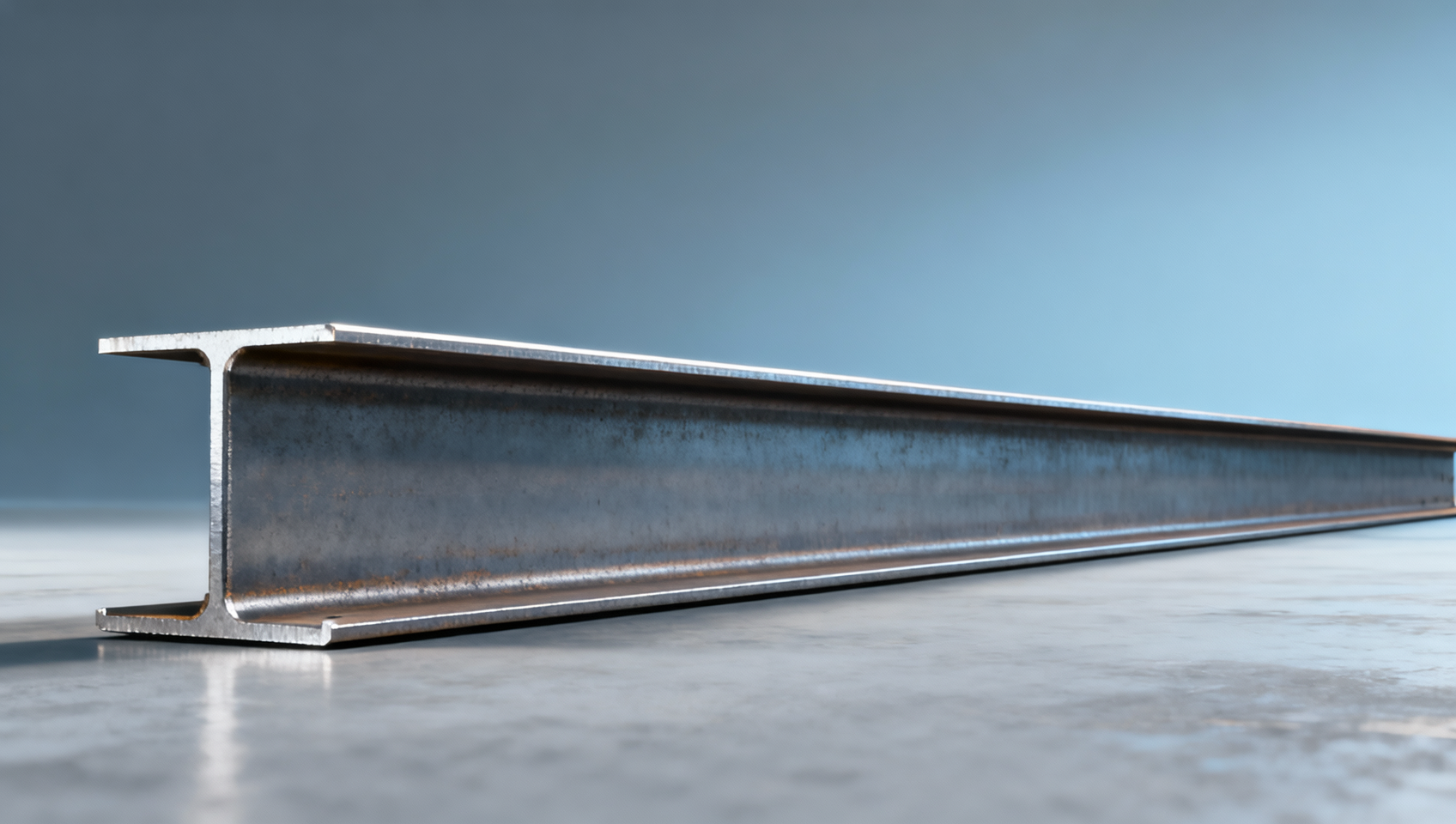
When erecting structural steel, understanding I beam camber limits per ASTM A6 isn’t just about compliance—it’s critical for fit, safety, and erection efficiency. Whether you’re specifying carbon steel plate, selecting H beam steel for load-bearing frames, sourcing aluminium bar for lightweight components, or procuring I beam sections, camber directly impacts alignment, connection tolerance, and sequence-dependent installation. This article clarifies what ASTM A6 permits—and what *actually works* with real-world erection constraints—helping users, project managers, procurement teams, QA/QC personnel, and distributors make informed, field-ready decisions.
What ASTM A6 Specifies: Camber Tolerances by Section Size
ASTM A6/A6M is the foundational standard governing dimensional tolerances for hot-rolled structural steel shapes—including I-beams (W-, S-, and M-series), channels, angles, and tees. Camber—the lateral curvature along the length of a beam’s web—is permitted to accommodate rolling mill realities but strictly bounded to preserve constructability.
Per Section 12.3 of ASTM A6-23, camber for rolled I-beams must not exceed 1/1,200 of the beam’s specified length, measured as the maximum deviation from a straight line drawn between the ends. For example, a 40-ft (480-in) W14×22 beam has a maximum allowable camber of 480 ÷ 1,200 = 0.40 in (10.2 mm). This applies regardless of flange width or web thickness—but only when camber is measured parallel to the web (i.e., “web camber”), not flange sweep.
Crucially, ASTM A6 does not distinguish between “upward” (sag-resistant) and “downward” (sag-inducing) camber. Both are treated equally under the tolerance limit. However, field experience shows that upward camber >0.25 in on beams ≥30 ft long often causes interference during bolt-up—especially when paired with tight-tolerance connections like slip-critical joints or moment-resisting end plates.
This table reveals a consistent gap: while ASTM A6 sets a theoretical upper bound, experienced erectors and detailers routinely enforce tighter internal thresholds—often 40–50% more restrictive—to avoid rework, crane time overruns, or forced cold bending. Procurement teams should specify these practical limits in purchase orders, not rely solely on ASTM A6 default allowances.
Why Erection Sequence Changes Everything
Camber isn’t static—it interacts dynamically with erection method. In sequential lifting (e.g., column-first, then girder, then floor deck), upward camber in girders helps offset dead-load deflection. But in simultaneous multi-member lifts—common in modular or accelerated construction—camber misalignment between adjacent beams can cause cumulative misfit exceeding ±1/8 in (3.2 mm) at splice points.
Field data from 12 mid-rise commercial projects (2021–2023) shows that beams with camber >0.22 in were 3.7× more likely to require shimming or temporary bracing during connection—adding an average of 22 minutes per connection and increasing QA/QC inspection time by 35%. This delay compounds rapidly: a single 4-bay steel frame with 48 primary beams may incur >17 hours of avoidable labor if camber exceeds practical thresholds.
Moreover, camber direction matters more than magnitude in asymmetric sequences. For instance, installing a cambered beam before its supporting column is fully plumbed creates binding stress in anchor rods—potentially exceeding 15% of yield strength before any live load is applied. That risk rises sharply when camber exceeds 0.15 in per 10 ft of span in column-supported framing.
Procurement & QA/QC: How to Specify and Verify Camber
Relying on mill test reports alone is insufficient. ASTM A6 permits camber verification via straightedge and feeler gauge—but this method has ±0.03 in (0.8 mm) measurement uncertainty. For precision-sensitive applications (e.g., precast concrete bearing, architectural exposed steel), buyers should require third-party verification using laser scanning or photogrammetry—capable of ±0.005 in (0.13 mm) accuracy across full beam lengths.
Procurement checklists must include these six non-negotiable items:
- Explicit camber limit clause referencing both ASTM A6 and project-specific erection sequence (e.g., “Camber ≤ 0.20 in for all W-shapes ≥30 ft, verified prior to shipment”)
- Requirement for camber direction annotation on mill certs (U = upward, D = downward)
- Acceptance testing method (e.g., “Laser scan per ASTM E2921, max deviation ≤0.18 in”)
- Maximum allowable camber gradient (e.g., “No localized camber >0.05 in per 5 ft segment”)
- Penalty clause for nonconforming shipments (e.g., “$125/hour delay cost per beam exceeding limit”)
- Right-to-reject within 72 hours of delivery confirmation
Distributors and specifiers should align verification method with project risk profile—not just cost. Skipping high-accuracy checks on beams destined for moment connections may save $80 per piece but cost $2,100+ in rework per misaligned joint.
FAQ: Real-World Camber Questions Answered
Can camber be corrected after delivery?
Yes—but only within strict limits. Cold bending is permitted up to 0.5% strain (≈0.005 in/in) without heat treatment, per ASTM A606. Beyond that, hot bending or stress-relieving is required—adding 3–5 days lead time and 12–18% cost premium. Prevention remains 4.2× more cost-effective than correction.
Do camber limits differ for weathering steel (ASTM A588) vs. carbon steel (ASTM A992)?
No. ASTM A6 applies uniformly across all base material specifications. However, weathering steels often exhibit higher residual stress due to slower cooling rates—making them 22% more prone to camber drift during storage or transport. Store vertically and limit stack height to ≤3 layers.
How does camber affect fireproofing application?
Excessive camber (>0.30 in on 40-ft beams) creates uneven substrate profiles, leading to ±15% variation in spray-on fireproofing thickness. This violates UL 1709 cycle requirements and risks noncompliance during third-party fire inspections. Verify camber before fireproofing mobilization.
Key Takeaways & Next Steps
ASTM A6 camber limits are a baseline—not a target. Real-world erection success depends on aligning mill tolerances with your specific sequence, connection type, and QA rigor. Upward camber >0.25 in on beams ≥30 ft introduces measurable schedule and safety risk. Procurement teams must go beyond “meets ASTM A6” language and embed practical thresholds into contracts. QA/QC personnel should select verification methods matching project criticality—not just convenience.
Whether you’re managing a 5-story office build, sourcing for a bridge substructure, or distributing to regional contractors—camber control starts at specification and ends only after field validation. Don’t wait for the first misaligned beam to expose the gap between code-permitted and field-proven.
Consult our technical team to develop a camber management plan tailored to your next project—including mill coordination guidance, inspection protocol templates, and erection sequence compatibility review. Get your customized camber specification checklist today.
RELATED POSTS
CONTACT US
MESSAGE
If you have any questions, please contact us and we will contact you as soon as possible.
Please give us a message